Vaping Frequency and Health: What’s the Safe Range?
The relationship between vaping frequency and health is one of the most pressing questions for anyone who uses e-cigarettes. How many puffs

Understanding the difference between vaping and smoking is essential for any adult considering a switch from combustible cigarettes to a vapour device. While both deliver nicotine, the way they produce it — and what ends up in your body — is fundamentally different. This guide breaks down how each method works, how they compare on key factors, and what Canadian regulations say about both.
If you’ve ever wondered what actually separates a vape from a cigarette, you’re not alone. The two products are often lumped together in conversation, but mechanically and chemically they operate in completely different ways. This article explains the difference between vaping and smoking in plain terms — covering how each works, what’s in the vapour versus the smoke, cost comparisons, and the regulatory landscape in Canada.
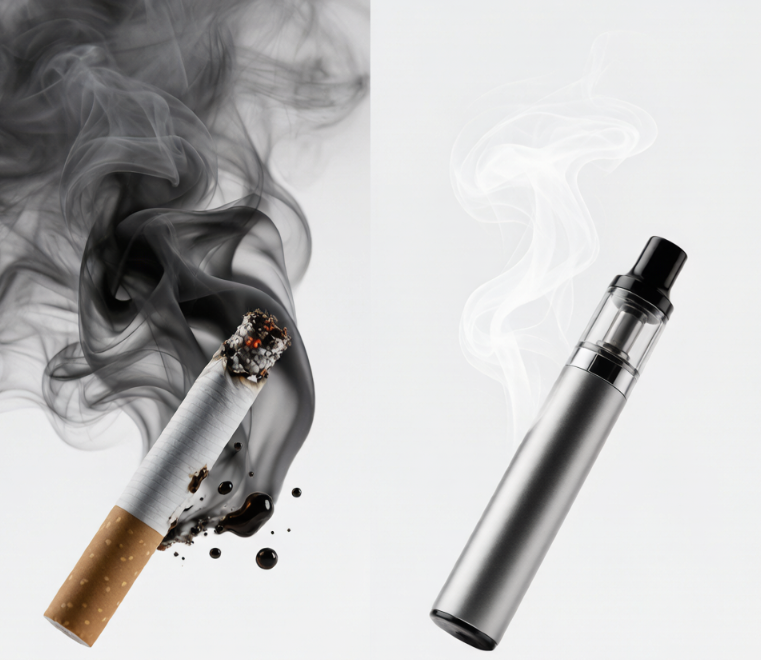
Smoking a traditional cigarette is, at its core, a combustion process. When you light a cigarette, the tobacco inside burns at temperatures reaching 600–900°C. This high heat breaks down the tobacco leaf and the thousands of chemical compounds it contains, producing smoke — a complex mixture of gases and tiny particulate matter.
The key point in the difference between vaping and smoking is this: combustion creates entirely new chemicals that weren’t in the original tobacco leaf. According to Health Canada, burning tobacco produces over 7,000 chemicals, including at least 69 known carcinogens.
When a smoker takes a drag, they inhale:
The combustion process is what makes smoking so harmful. It’s not the nicotine itself that causes lung cancer — it’s the thousands of byproducts created when organic matter burns. This combustion-byproduct issue is central to understanding the difference between vaping and smoking.
Vaping works on a completely different principle: vaporization. A vaping device (whether disposable or a pod system) uses a battery-powered heating element — usually a small coil — to heat a liquid solution called e-liquid or vape juice. The heat is enough to turn the liquid into an inhalable aerosol (commonly called vapour), but not hot enough to cause combustion.
This is the most important difference between vaping and smoking. There’s no burning, no tobacco leaf, and no smoke. The aerosol produced is fundamentally different from cigarette smoke in both composition and temperature.
A typical e-liquid contains four main ingredients:
These ingredients are heated, not burned, which is why the resulting aerosol contains far fewer chemicals than cigarette smoke.
| Factor | Smoking | Vaping |
|---|---|---|
| Mechanism | Combustion (burning) | Vaporization (heating) |
| Temperature | 600–900°C | 100–250°C |
| Produces | Smoke (thousands of chemicals) | Aerosol (far fewer compounds) |
| Contains tobacco | Yes | No |
| Contains tar | Yes | No |
| Contains carbon monoxide | Yes | No |
| Odor | Strong, lingers | Lighter, dissipates faster |
| Ash produced | Yes | No |
This table captures the difference between vaping and smoking at a glance. The absence of combustion in vaping means the chemical profile of what’s inhaled is substantially different — no tar, no carbon monoxide, and no ash.
It’s worth emphasizing: vaping products do not contain tobacco leaf. The nicotine in e-liquid is typically extracted from tobacco or synthesized, but the product itself is tobacco-free. This is a regulatory and chemical distinction that matters when discussing the difference between vaping and smoking.
If you are an adult who currently smokes and is looking for an alternative, understanding the difference between vaping and smoking can help inform your decision. Some smokers find that switching to vaping helps them avoid combustion, while others prefer nicotine replacement therapies or quitting entirely.
Talk to a healthcare professional. This article is informational only. For advice on reducing or quitting nicotine, visit Health Canada’s quit-smoking resources online or speak with your doctor.
Vaping is not intended for non-smokers or youth. Nicotine is highly addictive, and the long-term health effects of vaping are not yet fully understood. If you don’t already use nicotine products, starting to vape is not advisable.
The primary difference between vaping and smoking is the mechanism: smoking involves combustion (burning tobacco), while vaping involves vaporization (heating a liquid).
Vaping products are not safe or harmless. However, public health authorities including Health Canada generally acknowledge that vaping is likely less harmful than smoking combustible cigarettes. “Less harmful” does not mean “safe.” This article does not make health claims. Consult a healthcare professional for personalized advice.
Vaping products are not approved as smoking cessation aids in Canada unless specifically authorized by Health Canada. Some adult smokers use vaping as a personal alternative, but for evidence-based quitting support, speak with a healthcare professional or visit Health Canada’s quit-smoking resources.
In most Canadian provinces and municipalities, no. Vaping is treated similarly to smoking in indoor public spaces, workplaces, restaurants, and many outdoor areas.
Check out our full blog for more in-depth vaping guides, product reviews, and Canadian compliance updates — all written for adult vapers.Click Here to Visit WillVape Blogs Now
The relationship between vaping frequency and health is one of the most pressing questions for anyone who uses e-cigarettes. How many puffs
If you’re wondering can you vape after a filling, you’re not alone. Many vapers ask this exact question after leaving the