
Can You Vape After a Filling?
If you’re wondering can you vape after a filling, you’re not alone. Many vapers ask this exact question after leaving the


If you’ve ever wondered “can smoke detectors detect vape?” — the answer is a definitive yes. While vaping produces an aerosol rather than combustion smoke, the microscopic particles inside that vapour are frequently large and dense enough to set off both ionization and photoelectric smoke alarms. Whether you vape at home, in a hotel, or inside a rental car, understanding how your device interacts with smoke detectors can help you avoid false alarms, awkward explanations, and even costly fines.
To understand whether smoke detectors can detect vape, it helps to first understand how these devices function. The short version: smoke detectors don’t actually “know” what smoke is — they simply detect airborne particles that enter their sensing chamber. This is exactly why can smoke detectors detect vape is not a simple yes-or-no question — the answer depends on particle size, density, and detector type. Most residential and commercial buildings use two main types of smoke alarms, and both rely on detecting airborne particles rather than specifically identifying combustion smoke from fire.
Ionization alarms contain a small amount of radioactive material (typically americium-241) that ionizes the air inside a sensing chamber, creating a steady electrical current. When particles — from smoke, dust, or vape aerosol — enter the chamber, they disrupt that current. If the disruption is significant enough, the alarm triggers.
These detectors are particularly sensitive to very small particles, which is exactly what high-powered vaping devices can produce when used in enclosed spaces.
Photoelectric alarms use a light beam and a photosensor positioned at an angle inside a chamber. Under normal conditions, the light does not hit the sensor. But when particles scatter the light beam onto the sensor — whether those particles come from a fire or a dense cloud of vapour — the alarm goes off.
According to the National Fire Protection Association (NFPA), photoelectric detectors are generally more responsive to smouldering fires and visible smoke — but they are equally responsive to the dense, visible clouds produced by sub-ohm vaping.
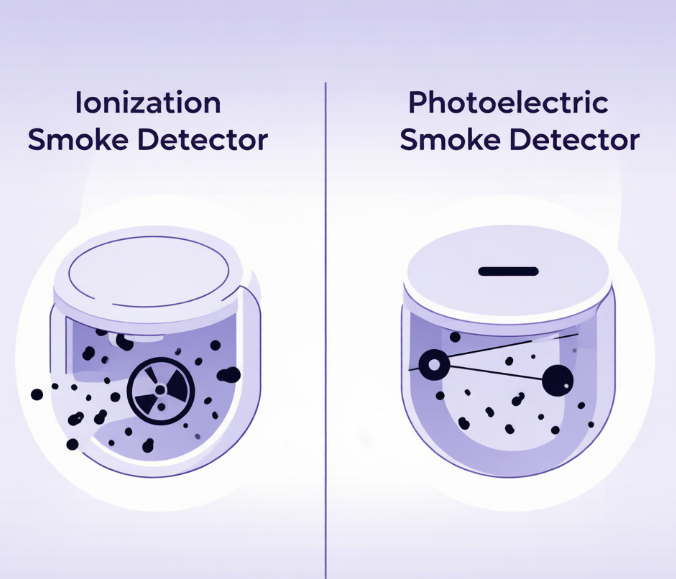
Yes — smoke detectors can detect vape. The aerosol produced by e-cigarettes and vaping devices contains suspended liquid particles (primarily propylene glycol, vegetable glycerin, flavourings, and sometimes nicotine). These particles are often in the same size range — 0.1 to 1.0 microns — as combustion smoke particles, making them more than capable of triggering a smoke alarm.
The key question isn’t really whether smoke detectors can detect vape, but rather under what conditions they will. When people ask “can smoke detectors detect vape?” they’re often surprised to learn that the answer depends on multiple factors. Several variables determine whether your vape cloud will actually set off an alarm.
| Factor | Effect on Detection |
|---|---|
| Detector type | Photoelectric sensors tend to be more easily triggered by dense vapour clouds than ionization sensors. |
| Vapour density | Sub-ohm devices producing large clouds are far more likely to set off alarms than low-wattage pod systems. |
| Room size | Vaping in a small, enclosed space (like a bathroom or hotel room) concentrates particles and increases alarm risk. |
| Ventilation | Open windows, running fans, or HVAC systems disperse vapour particles before they reach the detector. |
| Distance from detector | The closer you vape to a ceiling-mounted alarm, the higher the chance of triggering it. |
| E-liquid composition | High-VG e-liquids produce thicker, denser clouds that linger longer in the air and are more likely to reach alarm thresholds. |
This is one of the most common scenarios people worry about, and for good reason. Hotels typically use sensitive, interconnected smoke detection systems — and many have begun installing vape-specific detectors as well. If you’ve ever searched “can smoke detectors detect vape in hotels,” you already know it’s a widespread concern.
The consequences of vaping in a hotel room can include:
Yes, but it’s less likely. Pod systems and other low-wattage mouth-to-lung devices produce significantly smaller vapour clouds than sub-ohm mods. In a well-ventilated room, the particles typically disperse before reaching alarm thresholds. However, in a small, enclosed space like a bathroom with a sensitive detector, even a pod system can trigger an alarm.
It can. Cars are extremely small, enclosed spaces, and many newer vehicles have sensitive smoke detectors or air quality sensors built in. Vaping with the windows up almost certainly concentrates enough particles to trigger a sensor.
No. Heat detectors respond only to rapid temperature increases, not airborne particles. Vaping does not produce enough heat to trigger a heat-based detector.
Yes. Airport bathrooms often use highly sensitive, interconnected detection systems — and some have added vape-specific sensors.
Check out our full blog for more in-depth vaping guides, product reviews, and Canadian compliance updates — all written for adult vapers.Click Here to Visit WillVape Blogs Now
If you’re wondering can you vape after a filling, you’re not alone. Many vapers ask this exact question after leaving the
If you vape regularly and have a dental appointment coming up, you might be wondering: can dentists tell if you vape?